
To receive a B.S. in chemical engineering, students must complete 139 units of coursework required for the major, plus all college general education requirements. (Example: Warren students must take 48 units of general education coursework in addition to the 139 units of major requirements for a total of 187 units for graduation)
Every CENG course (except CENG-004 and CENG-199) must be taken for a letter grade. All courses must have a grade of C- or above as a passing grade. This includes all Math, Physics, and Chemistry courses that are part of the major requirements and all technical electives. A one-unit introductory seminar (CENG-004) is required of all incoming freshmen and transfer students.
The organization is shown in the chart below. Course descriptions can be found here.
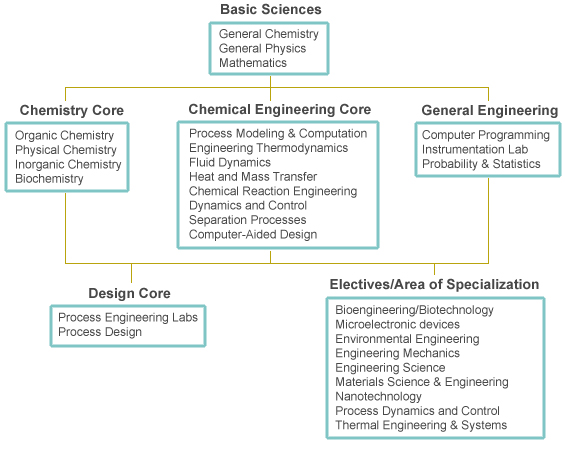
Course descriptions for core classes can be found here.
General education requirements (varied units):
This requirement is intended to fulfill the general education requirements (G.E.) from respective colleges.
The example above includes 48 units of G.E. requirements as required for Warren College students. Students in other colleges need to adjust the plan to match their own college requirements.
Basic sciences (fifty-four units):
This lower-division requirement includes twenty-four units of mathematics (MATH-018 (formerly MATH 020F) and 020A-E), fourteen units of physics (PHYS-002A-C, 002CL), and sixteen units of chemistry (CHEM-006A-C, 007L). All basic science courses required for the major must be taken for a letter grade.
Chemistry Core (twelve units):
Three advanced chemistry electives must be selected from among the pre-approved list: CHEM-041A, 041B, 041C, 043A, 114A (or BIBC-100), 114B (or BIBC-102), 120A, 120B, 130, 131, or 132. (Note: Students may not receive credit for both BIBC-100 and CHEM-114A, or BIBC-102 and CHEM-114B).
Chemical engineering core (thirty-three units):
This requirement covers chemical process modeling, solution thermodynamics, transport phenomena, chemical reaction engineering, process control, and unit operations (CENG-100, 101A–C, 102, 113, 120, 122). Also includes a one-unit introductory seminar (CENG-004) which is required of all incoming freshmen and transfer students.
Process laboratory and design (sixteen units):
This requirement is crucial to fulfilling the Chemical Engineering Program (B.S.) goals by providing hands-on and experiential instruction in the areas of project design, unit operations, hazards analysis, ethics, and economic analysis.
General engineering (twelve units):
This requirement covers basics in computer programming, probability and statistics, and instrumentation. The computer programming requirement can be satisfied with a course in Matlab (CENG-015). Probability and statistics can be satisfied with CENG-114. Instrumentation is satisfied with CENG-170*.
*CENG-170 has replaced MAE-170 for the Chemical Engineering major requirements. Students will not be given credit for both MAE-170 and CENG-170.
Technical Electives (twelve units):
Electives are intended to broaden and enhance professional goals. They may be chosen to achieve either breadth or depth in one’s education. All electives must be upper-division courses in engineering. Pre-approved courses are listed here. If students wish to follow an area of specialization, they must take all 3 electives from the same category. An area of specialization will not be noted on students' degree audits. With the exception of CENG-199, all technical elective courses must be taken for a letter grade.